%20copy.png)
What Roofing Maintenance Is Recommended Before Autumn in Cedar Grove, NJ?

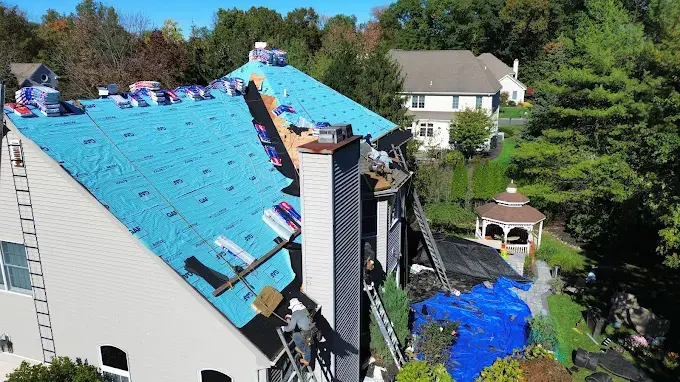
Pre-autumn maintenance is a short list of jobs, but it comes with a hard deadline attached. Sealant renewal at the flashing joints, valley clearing, fastener checks along the ridge and hips, and a ventilation review in the attic, all done while the weather is still warm enough for materials to actually cure.
Our crew runs through that list every September and October, because that's kind of what you'd expect from an efficient roofing contractor working in Cedar Grove. And the roofs we see in January, almost without exception, are the ones nobody touched back in October.
The work itself is unglamorous, and it's cheap compared to what it prevents. A roof that gets this attention every year tends to reach the end of its rated life without much drama. A roof that doesn't tend to need real work, sometimes five or six years early, usually because water crept into the decking through a joint that would've taken twenty minutes to reseal.
What Maintenance Work Happens on the Roof Itself?
The roof surface work starts with debris removal, mostly from the valleys and from behind any chimney or dormer. Those spots are basically where leaf litter piles up and just sits there, staying wet for weeks.
Wet organic material against asphalt shingles speeds up granule loss and feeds moss, and moss roots will slowly lift the shingle edge over time. It's not just cosmetic, it's honestly the difference between a shingle that lies flat through a windstorm and one that catches air and tears off.
After the debris is cleared, the crew works through the fasteners and the field. Nails back out over years of thermal cycling, and a nail head that's backed out just enough will lift the shingle above it and break the seal.
Those get driven back down and resealed on the spot. Lifted shingle tabs get the correct adhesive at the correct temperature too, which honestly isn't something you can replicate in December.
Each of these is maybe a ten-minute fix in September. Skip it, though, and it turns into a much bigger conversation once water's been getting in all winter, sometimes even pushing you toward a full residential roof replacement sooner than you'd planned. That's the whole point of catching it now instead of later.
Which Joints and Seals Need Attention Before the Wet Season?
Every place the roof plane gets interrupted needs a look. That's chimney flashing, vent stack boots, sidewall flashing, and the seams around any penetration through the deck.
Rubber vent boots are probably the most common failure point on a New Jersey roof because the rubber hardens and cracks under UV exposure long before the shingles around it start to show their age. A cracked boot puts water straight onto the decking, and it does it quietly, which is kind of the problem.
Sealant at those joints has a working life measured in years, not decades, so it doesn't last forever no matter how good the brand is. Renewing it before the wet season is routine work, but it has to be done right, meaning the old failed material comes off first instead of just layering fresh sealant on top.
We've opened up chimney joints with four layers of old caulk stacked up and rot sitting right underneath, which is exactly why catching things early is part of how inspections help prevent future issues down the line. The stacking is really what hides the problem until a stain shows up on the ceiling.
What Does the Attic Side of Maintenance Involve?
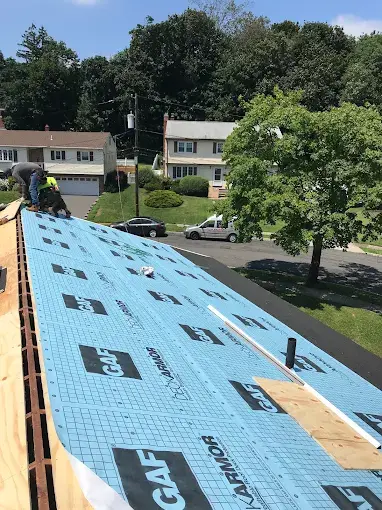
Honestly, half of a roof's working life gets decided by what happens under the deck, not on top of it. Warm, moist air from the house rises into the attic, and if the ventilation isn't moving it out fast enough, it condenses on the underside of the sheathing through the cold months.
That moisture rots the decking from the inside, and no inspection from above is going to catch it until the plywood goes soft.
A pre-autumn review checks that intake at the eaves isn't blocked by insulation, that exhaust at the ridge is open and doing its job, and that bathroom and kitchen fans actually vent outside instead of into the attic space.
Those three things together cost very little to fix, and they change how the roof performs in both directions since the same airflow that stops winter condensation also keeps the shingles cooler come July. It's a small thing, but it adds up, and it's honestly one of the clearer benefits of regular roof maintenance that homeowners tend to overlook.
Noticed a cracked vent boot or maybe a bit of daylight around the chimney flashing? Give us a call at (973) 857-9449, and we'll take a look before it turns into a bigger problem come winter.
When Should This Be Scheduled in Essex County?
The practical window opens in early September and closes once the first sustained cold snap hits, which around here usually shows up in the back half of November.
Booking inside that window just means the sealant actually cures, the adhesive bonds properly, and the crew isn't working around frost on the deck. It also means the job wraps up before the heaviest leaf drop, so the valleys stay clear through the season instead of getting cleared once and refilling two weeks later.
Scheduling early has a second upside too, and it has nothing to do with weather. Every roofer in Essex County ends up booked solid the week after the first big storm, and emergency calls jump ahead of maintenance every time.
Call in September, and you get a date that works for you. Call after the first November nor'easter, and you're in a queue behind people with actual water coming through their ceiling.
Our team offers a free roof inspection before any quote, so you can find out whether your roof just needs maintenance or something more before committing to anything.
What Does Skipping a Season Actually Cost?
Skipping one autumn rarely causes a leak all by itself, at least not right away. What it does is move every small problem one step further down the line. The backed-out nail becomes a lifted shingle, the lifted shingle becomes a wind-torn section, and the open flashing joint slowly becomes a wet rafter.
None of that is visible from the ground while it's happening, which is why the first sign for most homeowners is a stain on a bedroom ceiling sometime in February.
The cost difference is substantial, and it compounds fast. Resealing a chimney joint is minor work, plain and simple. Replacing a section of wet decking, the underlayment above it, and the shingles above that, then dealing with whatever the moisture did to the insulation, is a completely different job.
Ventilation neglect follows the same pattern too, since condensation damage builds up over several winters and often ruins a roof that's still well within its rated lifespan.
Have questions about scheduling your pre-autumn visit, or just want to talk through what your roof might need first? Contact us, and we'll help you figure out the right next step. You can also reach us at (973) 857-9449 or info@roofingpronj.com. We're here Monday through Sunday, open 24 hours.
Related Topics:

Comments